A contractor's guide to what actually lasts here
Most exterior paint guides are written for the mainland. They'll tell you a quality acrylic lasts ten to fifteen years, which is true in Ohio and wrong in Hawaii.
Here, a premium coating on a full-sun coastal elevation might give you six years. The same product on a shaded, inland wall might give you twelve. The product matters — but where your house sits matters more, and almost nobody explains that part.
We've painted more than 4,000 projects across Oahu and Maui since 2007. This is what we've learned about which paints hold up, where, and why.
Why exterior paint fails faster in Hawaii
Three forces work against your paint here, and each one attacks differently.
UV exposure
Hawaii sits at roughly 21 degrees north latitude and receives substantially more direct ultraviolet radiation than the continental United States. UV breaks down the resin binder that holds pigment to the surface.
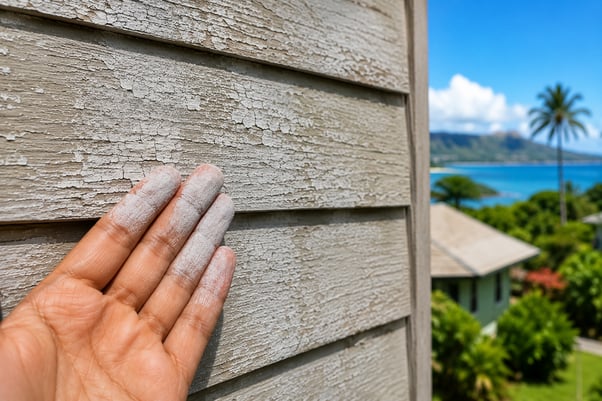
You see it first as chalking — a powdery residue when you run your hand down the wall — followed by fading. South and west-facing elevations go first, often years ahead of the rest of the house.
Salt air
Properties within about a mile of the shoreline take continuous salt deposition. Salt is hygroscopic, meaning it pulls moisture out of the air and holds it against the surface.
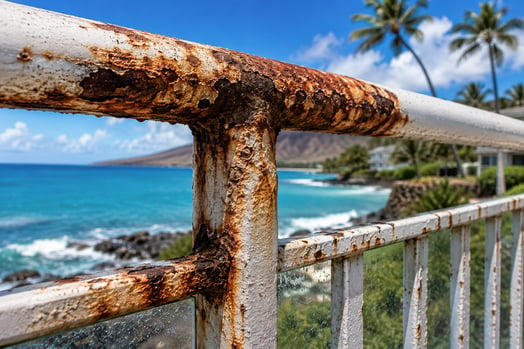
Here's the part most homeowners don't expect: on coastal properties, the metal usually fails before the paint does. Fasteners, railings, flashing, and door hardware corrode from underneath, and rust bleeds through an otherwise intact finish. Choosing a better topcoat doesn't fix that — the primer specification does.
Humidity and rain
Windward and shaded elevations hold moisture long enough for mildew to establish beneath the coating. Once it's under the film, it lifts paint off the substrate no matter how good the product is.
This is why Kailua and Ewa Beach need different answers. Windward walls fail from moisture. Leeward walls fail from UV. A crew that treats them the same gets one of them wrong.
Paint is a system, not a product
Before comparing products, one thing worth understanding: the topcoat is the part you see, not the part that determines how long the job lasts.
A complete exterior system is:
- Surface preparation — washing, mildewcide treatment, scraping, sanding, repair
- Caulking — joints, trim, penetrations
- Primer — matched to the substrate and the exposure
- Two finish coats — the paint everyone talks about
Most failures we're called to inspect trace to steps 1 through 3, not step 4. A premium topcoat over unprepared, unprimed substrate will fail faster than an economy product applied correctly.
So read the comparison below as "assuming everything underneath is done right."
Sherwin-Williams exterior paints, compared
We specify Sherwin-Williams because we've watched these products perform in Hawaii conditions for nearly two decades, and because we're a Sherwin-Williams Certified Painting Contractor with access to their technical support on substrate and exposure questions.
Here's how the lines differ.
Emerald® Exterior
Best overall performance
Sherwin-Williams' premium exterior acrylic. The highest resin quality and pigment loading in the line, which is what drives UV resistance and color retention.
Expected service life in Hawaii: 8–10 years on sheltered and inland elevations, 6–8 years on full-sun or coastal exposures.
Best for:
- Homeowners planning to stay long-term
- Coastal properties
- Full-sun south and west elevations
- Deep or saturated colors, which fade fastest
Why it costs more: higher-grade acrylic resin and more pigment per gallon. On a full repaint the material difference between Emerald and Duration is usually a small fraction of total project cost, because labor and prep dominate the budget.
Emerald® Rain Refresh
Best for windward and rainy areas
Everything Emerald offers, plus a self-cleaning surface technology. Rain sheets across the finish and carries dirt and debris with it rather than letting it settle.
Expected service life in Hawaii: 8–10 years, with noticeably less accumulated staining over that period.
Best for:
- Windward Oahu — Kailua, Kaneohe, Waimanalo
- Upcountry Maui — Makawao, Pukalani, Kula
- North Shore on either island
- Homes surrounded by trees, where organic debris and mildew are constant
- Anyone who doesn't want to pressure wash every year
The honest caveat: this is worth the premium in genuinely wet locations. On a dry leeward property in Kapolei or Kihei, standard Emerald makes more sense.
Duration® Exterior
Best value for most homes
Our most-specified product, and for most Hawaii homes it's the right answer. Strong weather resistance and built-in mildew resistance at a meaningfully lower price than Emerald.
Expected service life in Hawaii: 6–8 years typical, 5–6 years on harsh coastal or full-sun exposures.
Best for:
- The majority of Hawaii homes
- Homeowners who want premium protection without the top-tier price
- Properties with mixed exposure, where one product covers the whole house
SuperPaint® Exterior
Reliable mid-range
A dependable coating without the advanced resin technology of the premium lines.
Expected service life in Hawaii: 5–7 years in moderate conditions, less on coastal or full-sun.
Best for:
- Rental and investment properties
- Homes being prepared for sale
- Budget-conscious projects where a shorter repaint cycle is acceptable
A-100® Exterior
Budget-friendly
Sherwin-Williams' economy exterior line. It's a legitimate product properly applied — just don't expect premium longevity from it.
Expected service life in Hawaii: 4–5 years, less in harsh exposures.
Best for:
- Properties being sold in the near term
- Investment properties on a short repaint cycle
- Situations where budget genuinely governs the decision
Comparison at a glance
| Paint | Expected life in Hawaii | UV resistance | Mildew resistance | Best for |
|---|---|---|---|---|
| Emerald | 8–10 yrs | ★★★★★ | ★★★★★ | Long-term ownership, coastal, full sun |
| Emerald Rain Refresh | 8–10 yrs | ★★★★★ | ★★★★★ | Windward, Upcountry, wooded lots |
| Duration | 6–8 yrs | ★★★★☆ | ★★★★☆ | Most Hawaii homes — best value |
| SuperPaint | 5–7 yrs | ★★★☆☆ | ★★★☆☆ | Rentals, mid-range budgets |
| A-100 | 4–5 yrs | ★★★☆☆ | ★★★☆☆ | Short-term, budget projects |
Ranges assume correct preparation and priming. Coastal and full-sun elevations run at the low end.
Three situations where the topcoat isn't the main decision
Coastal properties — the primer matters more
Within about a mile of the shoreline, the failure you'll see first is rust bleeding through around fasteners, railings, and flashing — not paint breaking down.
On coastal exterior work we specify corrosion-inhibiting primers on all metal components as standard, not as an upsell. Skip that and you'll be looking at rust stains on a two-year-old paint job regardless of which topcoat you chose.
Stucco and concrete block — consider elastomeric
Stucco and CMU are common across Hawaii and prone to hairline cracking. Standard acrylic bridges some movement; elastomeric coatings are formulated to stretch across hairline cracks and keep wind-driven rain out of the substrate.
Worth specifying on:
- Stucco with existing hairline cracking
- Concrete block walls
- Resort-density construction in South and West Maui
- Any property taking wind-driven rain
Elastomeric is thicker, costs more per square foot, and requires proper application to avoid trapping moisture. It's not automatically better — it's better for the right substrate.
Windward and shaded elevations — treat before you prime
Mildew that isn't killed before priming grows back through the new coating. On shaded walls, stairwells, north elevations, and anywhere under tree cover, mildewcide treatment before priming matters more than the topcoat's mildew rating.
What sheen should you use?
Rarely discussed locally, and it affects both appearance and durability.
Flat — hides surface imperfections best, but holds dirt and moisture. We generally avoid it on Hawaii exteriors except on stucco where the texture demands it.
Satin — the default for most Hawaii homes. Enough sheen to shed water and clean easily, not so much that it highlights every wall imperfection.
Semi-gloss — for trim, doors, and railings. Cleans well and stands up to handling. Also the right choice on metal components.
Gloss — front doors and accent elements only. Shows every flaw on a large surface.
One color note: deep, saturated colors fade faster everywhere, and considerably faster under Hawaii UV. If you want a dark exterior, Emerald's color retention is worth the upgrade — it's the difference between a color that holds and one that looks tired in four years.
So which one should you choose?
Rather than defaulting to the most expensive option, work through this:
How long will you own the home? Staying ten-plus years — Emerald or Rain Refresh. The cost difference amortized over the extra years usually favors the premium product. Selling within a few years — SuperPaint or A-100 does the job.
How far are you from the ocean? Within a mile — go premium on the topcoat and insist on corrosion-inhibiting primers on metal. Inland — Duration is usually the right call.
Which way does the house face? Full sun on south and west walls pushes you toward Emerald. Mostly shaded or windward pushes you toward Rain Refresh.
How much rain and shade? Kailua, Kaneohe, Upcountry Maui, North Shore, or a wooded lot — Rain Refresh earns its premium. Kapolei, Ewa, Kihei — it doesn't.
What's the substrate? Stucco or CMU with cracking — discuss elastomeric. Wood siding — standard acrylic with attention to prep and spot-priming.
We walk every property before quoting, look at which direction each wall faces, and specify accordingly. Two homes of identical size can need genuinely different systems.
Application matters as much as product
The best paint available will fail early if what's underneath it wasn't done properly. Our exterior process:
- Soft washing the full exterior, with mildewcide treatment on shaded and windward elevations
- Scraping and sanding failed coating, feathering the edges so transitions don't telegraph
- Repair of cracks, holes, and wood rot before any primer goes on
- Re-caulking joints, trim, and penetrations
- Priming matched to substrate and exposure, including corrosion-inhibiting primer on coastal metal
- Two finish coats of the specified system
- Masking and protection for landscaping, walkways, and fixtures throughout
Preparation is the largest single factor in how long your paint lasts. It's also the easiest place for a contractor to cut cost invisibly, which is why our estimates break prep out as its own line rather than folding it into a single number.
Frequently asked questions
What is the best exterior paint for Hawaii?
For most Hawaii homes, Sherwin-Williams Duration offers the best balance of durability and cost. For coastal properties, full-sun elevations, or long-term ownership, Emerald delivers meaningfully longer service life. In consistently wet areas like Windward Oahu or Upcountry Maui, Emerald Rain Refresh adds self-cleaning technology that keeps the finish looking better between washes.
How long does exterior paint last in Hawaii?
Most Hawaii exteriors need repainting every five to eight years, compared to ten or more on the mainland. Premium systems on sheltered elevations can reach 8–10 years. Coastal and full-sun exposures run shorter regardless of product. Preparation quality affects the outcome as much as product choice.
Is Emerald worth the extra cost over Duration?
It depends on how long you'll own the home and how harsh the exposure is. On a coastal or full-sun property where you plan to stay ten years, Emerald's longer service life usually costs less per year than repainting sooner with Duration. On a sheltered inland home, Duration is often the better value.
What paint should I use near the ocean?
Choose a premium acrylic with high UV resistance, but the more important decision is the primer. Properties within about a mile of the shoreline need salt-air-rated primers and corrosion-inhibiting products on all metal fasteners, railings, and flashing. Those components typically corrode before the paint film itself shows failure.
Do I need elastomeric paint on stucco?
Not always. Elastomeric is worth specifying on stucco or concrete block with existing hairline cracking, or where wind-driven rain is a concern. It bridges cracks that standard acrylic cannot. It costs more and requires correct application to avoid trapping moisture, so it should be specified for the substrate rather than applied by default.
What sheen is best for Hawaii exteriors?
Satin for most wall surfaces — enough sheen to shed water and clean easily without highlighting imperfections. Semi-gloss for trim, doors, and metal railings. Flat is generally avoided on Hawaii exteriors because it holds dirt and moisture, though it's sometimes appropriate on heavily textured stucco.
When is the best time of year to paint in Hawaii?
April through September is generally the driest and most predictable window. Windward, Upcountry, and North Shore projects need schedule flexibility year-round because of passing showers and fog. Exterior work should pause during rain rather than proceed on damp surfaces.
Get a recommendation for your property
The right paint depends on your exposure, substrate, budget, and how long you plan to stay. We'll walk your property, assess each elevation, and specify a system that fits — then put it in a written, itemized estimate at no cost.
Serving all of Oahu and Maui. Licensed Hawaii contractor BC-28938.